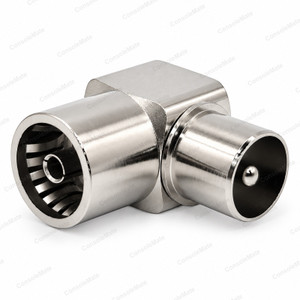
PAL Male Plug to BNC Female Socket Adaptor — TV Aerial / Antenna to BNC, Nickel
A small rigid adaptor that puts a BNC female socket on one end and a PAL (Belling-Lee) male plug on the other. Australian televisions, wall plates, set-top boxes and tuners use PAL; security cameras, DVRs, video test gear, scanners and a great deal of radio equipment use BNC. About 35 mm of machined metal with nothing inside it to go wrong.
Check compatibility
Check the gender before you order. This one is PAL male to BNC female. If you need PAL female, or a BNC male, that is a different adaptor — see the note in the description
Key product details
- PAL (Belling-Lee) MALE plug on one end, BNC FEMALE socket on the other. The PAL end pushes into a TV aerial socket; the BNC end accepts a BNC male plug
- Lets a BNC lead plug into a TV aerial input — the usual reason people buy it is a security camera, DVR or test lead that ends in BNC and a television, set-top box or tuner that only has a PAL antenna socket
- Also used the other way round by radio and scanner owners: a BNC-terminated antenna lead onto a PAL socket on a tuner, SDR dongle or FM/DAB receiver
- One-piece rigid adaptor — no cable, no lead, nothing to power. Roughly 35 mm long, it simply changes the connector
- Nickel-plated brass body with a gold-plated centre pin, knurled grip band so it can be pushed on and pulled off without pliers
- Proper bayonet BNC socket with two locking studs — a BNC plug twists on and locks, it does not just push into place and fall out
- Completely passive: no power, no batteries, no configuration, nothing to fail
- We do not publish an impedance figure for this adaptor because our supplier does not specify one — fine for TV, CCTV and general antenna work, but see the description if you need a guaranteed 50Ω part
- 12-Month Warranty
About this item
The commonest job is a camera into a television: analogue CCTV and most reversing or gate cameras terminate in BNC, and there is nowhere on a TV to put that. The reverse is just as common — an antenna lead that ends in BNC (a scanner whip, an SDR pigtail, an FM or DAB wire aerial) needing to reach a PAL socket.
The BNC end is a socket, not a plug. It takes the male BNC connector on your camera or antenna lead, which twists a quarter turn and locks onto the two bayonet studs — it will not shake loose the way a push-fit connector does. The PAL end is a plug, and it pushes into the aerial socket on a TV, wall plate or set-top box.
Please check you want this gender. Four adaptors in this family look almost identical in a photograph. This listing is PAL MALE to BNC FEMALE. If you need PAL female to BNC female — because your TV lead already ends in a PAL plug — search our store for the all-socket version. A BNC male for a BNC socket is a different part again. Quickest check from the photographs: a pin in a plain barrel is the PAL plug, and the barrel with two little studs is the BNC socket.
Check these alternatives
Need a PAL socket instead of a PAL plug? Choose our PAL female to BNC female adapter instead. Both ends of that alternative are sockets; neither adapter converts the signal.
Choose only what your setup needs. Linked items are sold separately.
One honest limitation. Most competing listings advertise “75Ω”. Our supplier does not specify an impedance for this part, and 50Ω and 75Ω BNC parts are mechanically identical, so we will not print a figure we cannot stand behind. For television, CCTV, set-top boxes, tuners and general antenna work the distinction makes no practical difference at these frequencies. If you need a specified 50Ω path for laboratory, amateur radio or instrumentation work, buy an adaptor sold with a stated impedance.